Building the foundation that makes transformation stick.
I build things that make change possible: playbooks, toolkits, capability frameworks, talent models, assessment approaches, measurement philosophies, integration applications, and change practices from scratch. My center of gravity has always been technology — because adoption only works when people, process, and tools are designed to move together.
Today, that means helping organizations navigate AI and digital transformation with intention — because function always wins over form. The new interface gets the standing ovation. The slick GUI gets the budget approval. But familiarity will always be preferred over party tricks, and the party tricks almost always come with complexity. The real failure isn't technical. It's the Field of Dreams assumption: build it and they will come. That only worked because everyone already understood baseball and wanted to play. Technology adoption is also fundamentally exclusionary when built without the people it's meant to serve — and the people closest to the work know what they need better than any third-party implementation partner ever will. If we expect adoption, we have to build for it. That's where I start.
I like puzzles. Always have. My dad ran a computer repair shop when I was a kid, and I used to play early PC games on whichever machine was "almost fixed" — Commander Keen, Descent, Duke Nukem. I loved the missions that sent you off searching for an obscure item or trying to remedy some unknown galactic crisis. Emboldened by the opportunity, I'd rush into battle, only to find myself woefully unprepared for what was really going on. I did, however, learn how to think on the fly — and got better at absorbing the atmosphere before choosing an intervention. What I learned, in a way, was how to learn.
I came to project and change management the way most people do — sideways. It's the curious case of it all that keeps me coming back, and usually not the one you were pointed toward in the beginning. Uncovering the uncomfortable driver of dysfunction may sound like the grand prize, but showing someone the inside of their junk drawer rarely goes well without a lot of tact. What makes it interesting is that what feels like the problem to me may not be the problem to someone else — and ultimately, I don't own it in the long run. So it comes down to two questions:
Now the work begins — the real work, whatever it is. This is the level I work on: the one that sets the foundation for successful transformational change. Because at the end of the day, most change fatigue I've observed is linked to solving, and re-solving, for the wrong problem at the wrong level.
It may have been a while since my early exposure to problem solving in the back office of my dad's computer shop, but that experience didn't just teach me the work. It shaped how I approach it. Over time, those lessons became something more intentional: a set of principles I carry into every engagement:
In our new era of automation, expanding digital experiences, and changing methods of collaboration and connection, I believe people are the key to success. Tools are only as good as the people trained to use them, and their value is a measure of collaboration efficiency. Technology itself is rarely the reason a change initiative fails — it exposes the existing failures within a system. Diffuse decision authority, lack of leadership readiness, misaligned incentives, invisible constraints — they all lead to the same outcome: people weren't prepared. That's exactly what I diagnose and work with leadership to fix.
Start with people. Align with process. Leverage technology. In that order, always.
I hold an MBA from Marylhurst University, a BS in Psychology & Sociology from Oregon State, PROSCI certification, and recently completed Gen AI for Business Leaders (EdX / MIT Sloan). Pacific Northwest based, flexible on hybrid and select relocation.
"Rachel has continued to deliver exceptional results for our clients while driving internal value and efficiency. She is not only a rising star on our team but in the consulting profession as a whole."
— Amy Weeden, Managing Partner & Co-Founder, Propeller Consulting
Built complete change management practices from zero: playbooks, staffing models, revenue frameworks, GTM strategy, and pillar-by-pillar operational systems.
Designing behavior-change programs for AI and technology adoption — beyond training decks to actual usage, proficiency, and sustained ROI.
Built enterprise CM measurement frameworks distinguishing completion from success — NPS, utilization rates, task productivity, manager visibility, and business KPI alignment.
Sponsorship coaching, resistance mapping, executive communication design, and building the organizational will to see change through.
Organic and inorganic growth frameworks, acquisition criteria, practice P&L management, and business development playbooks.
Competency frameworks, CM 101/201 training programs, onboarding curricula, and community-of-practice infrastructure for scaling delivery quality.
Most CM leaders reach level 2. The full arc is rare.
CM plans, stakeholder maps, impact assessments, comms, training design — solo delivery on individual projects. The craft before the title.
Quality oversight, resourcing, coaching, client relationship management across a team of practitioners. Multiply the work through people.
P&L ownership, methodology design, talent pipeline, IP creation, GTM strategy. $0 → $12M+ revenue at Propeller.
Multi-workstream institutional transformation. Post-M&A McKinsey continuation at National University. IS org restructure, PMO dissolution, 18-workstream roadmap at SHIS.
Shaping how organizations think about AI adoption at the methodology level. Building Orbit. Advising at Mosaic. Setting the standard for the people-side of the AI transition.
These artifacts represent real work product built across my career — strategy documents, operational frameworks, measurement systems, and client-facing intellectual property. Click any card to read the full case.
Led OCM strategy and PM execution for a full enterprise IS transformation: org restructure across 8 functional areas, PMO dissolution and EPMO standup, service management overhaul, career framework, span-of-control redesign, and governance buildout. Owned the transformation roadmap, stakeholder communications cascade, OCM readiness scoring by team, and success metrics.
Project managed a 4-phase population health technology implementation at OHSU — Epic-integrated registry build, clinical metric creation, ACO measurement, claims data integration, and clinical governance standup. Tracked milestones across BI, app, and clinical workstreams; managed risk with steering committee; coordinated payor contracting and clinical sponsor engagement.
A dual-lifecycle integration framework mapping PM and CM activities across five project phases — from Initiation through Close — showing exactly where the two disciplines must interlock. Includes Agile variant, roles & responsibilities alignment guide, and methodology-specific integration notes for Lean, Six Sigma, and Program Management environments.
The foundational blueprint I authored for standing up Propeller's People & Change practice from scratch. Covers all six operating pillars: Business Development, Brand & Marketing, Talent Acquisition, Competency Development, Thought Leadership, and Revenue modeling — with scoring rubrics, GTM criteria, and first-year milestones.
Annual strategic plan for the P&C practice targeting $4.8M revenue (60% YoY growth). Introduced OKR framework into quarterly planning, defined three-year roadmap, and built the measurement infrastructure to pace progress. Reflects practice maturation from scrappy build to institutionalized operating model.
A client-facing IP document reframing how organizations measure change outcomes. Distinguishes completion metrics (training attendance, communication sends) from success metrics (adoption, proficiency, utilization, business KPI movement). Includes three-level measurement model, data collection plan, and a live case study with pre/post analysis.
Market positioning document built from 64 workshopped data points across client pain categories. Includes competitive landscape comparison against Deloitte and FTI Consulting, customer value proposition canvas, and service differentiation analysis. Foundation for how Propeller's CM practice positioned itself in a crowded market.
A 47-slide strategic analysis of organic vs. inorganic growth paths for a professional services firm at inflection. Covers product line expansion limitations, audience expansion ceilings, acquisition criteria, pursuit process, and success metrics. Built as the executive strategy brief for how Propeller could move beyond its current growth ceiling.
Cross-practice portfolio dashboard showing Change Management at $5.58M billed + backlog vs. $6.14M EOY target by July — 104% YTD. Tracked across five operational pillars simultaneously: Business Development, Brand & Marketing, Talent & Competency, Thought Leadership, and Service Development.
Conference presentation co-developed and co-delivered at ACMP Global 2019: "Be Agile — Driving Change in the Fast Lane." Introduced a four-tactic Agile CM framework (Customer First, Grow Relationship, Adapt & Adjust, Self-Directed) with a scored business readiness assessment, stakeholder management tooling, and sprint artifact templates.
Client-facing toolkit for building change-resilient organizational culture. A four-step system: identify culture groups, define and quantify organizational values, determine cultural barriers to change, and activate cultural pillars in change planning. Designed to make culture a strategic asset rather than a change obstacle.
Orbit is a diagnostic and navigation system for organizational change. It starts before the plan — by determining whether the conditions for change actually exist — and guides practitioners through execution with frameworks and AI-assisted insights that are proportional to the complexity at hand. Orbit doesn't force change. It reveals whether change is possible, what's in the way, and what it would take to move forward.
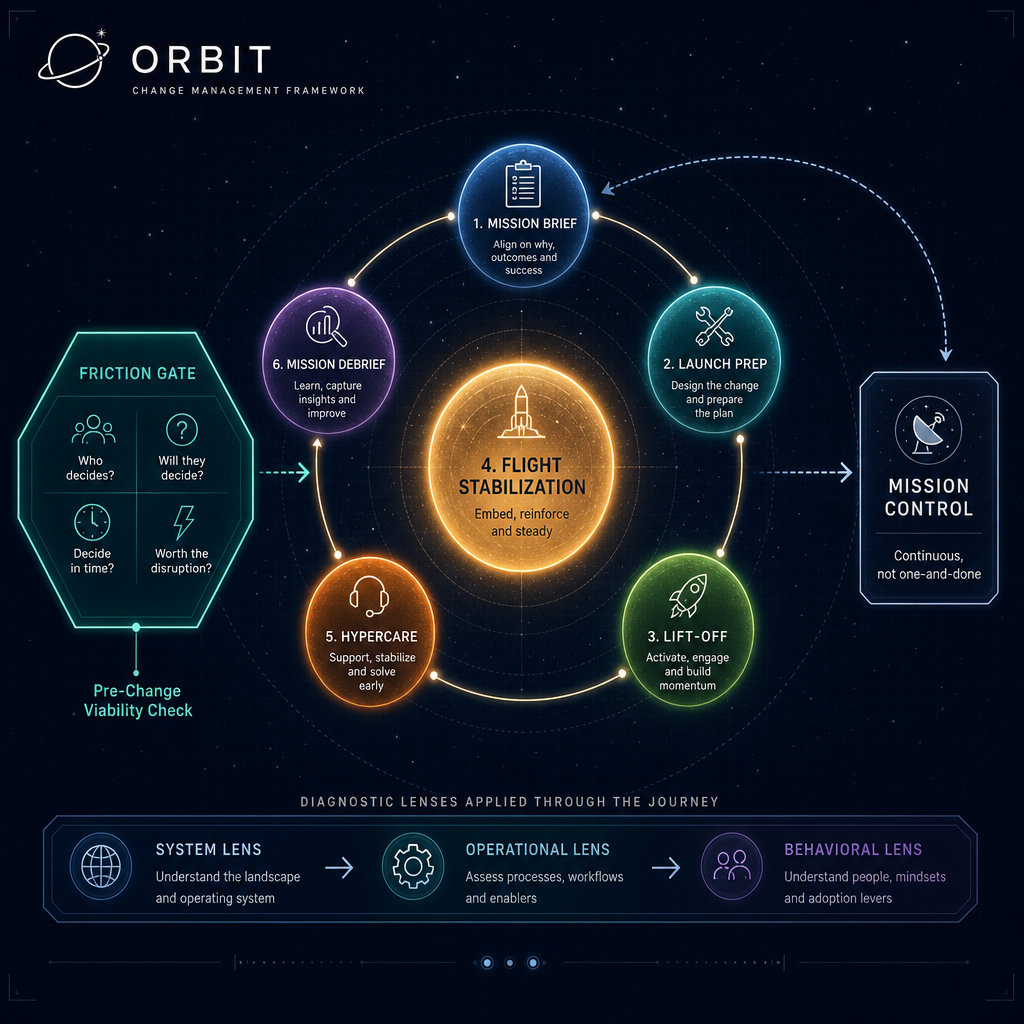
Orbit Change Management Framework — proprietary methodology © Rachel Crocker Boyl
"Every major change framework — ADKAR, Kotter, Prosci — starts at execution. They assume the change is already viable when it hits the practitioner's desk. Orbit starts before that: at the question of whether the organization can actually absorb what it's about to be asked to do. That upstream question determines whether the $2M transformation investment lands or evaporates. Nobody built a rigorous tool to answer it. So I did."
A pre-change viability check built around four questions. The Gate runs at project start — and again at every major inflection. It's a recurring pressure test, not a one-time entry ticket.
Organizations don't fail at change because people are resistant. They fail because new capability enters the system faster than the system can absorb it. Friction isn't the enemy — undiagnosed friction is.
Orbit maps five friction zones that predict absorption failure: Decision Authority Diffusion, Incentive Misalignment, Constraint Opacity, Signal Attenuation, and Temporal Mismatch. Zones 4 and 5 are downstream symptoms of 1–3 — the diagnostic sequence matters.
Every other framework measures lagging indicators — adoption rates, utilization numbers, post-go-live surveys. By the time those signals arrive, recovery is expensive. Orbit works upstream: Beliefs are the real leading indicator. What people believe before the change predicts whether they'll adopt it after.
Four real-time leading signals tracked across the lifecycle — before behavior has a chance to go sideways.
Every Orbit friction zone shows up in AI rollouts at maximum intensity. Decision authority is diffuse — who actually owns AI governance? Incentive misalignment is structural — why would a domain expert adopt a tool that might replace their expertise? Constraints are opaque — data quality, integration debt, compliance gaps nobody mapped. Signals attenuate — frontline adoption data never reaches the executive sponsor. And temporal mismatch is endemic — AI deployment moves at product speed; organizations learn at human speed.
Orbit didn't start as an AI adoption tool. It started as a response to the consistent failure modes I watched organizations repeat across 15 years of enterprise change work. It turns out those failure modes are the exact profile of an AI adoption program in trouble. The methodology arrived before the use case found it — which is the right order.
Co-presented at ACMP Global 2019. Challenged the profession to integrate Agile sprint methodology into change management delivery — before it was common practice. Included live readiness assessments and a four-tactic adoption framework. Co-presenters: Sunil Kasturi (Propeller) and Adella Chong (VMware).
Synthesized 64 market research data points to build a rigorous CM value proposition, competitive landscape map, and service differentiation framework. Used to reposition Propeller's CM practice against Deloitte and FTI — identifying gaps those firms couldn't serve.
Designed and documented a Communities of Practice strategy for a multi-geo consulting firm, examining CoP structure, success metrics, artifact creation, and the calibration between internal capability-building and external brand development. Grounded in Jean Lave & Etienne Wenger's foundational research.
Developed and published a framework distinguishing activity completion from behavioral adoption — a critical gap in how most organizations evaluate change ROI. Introduced a three-tier measurement model and data collection framework now embedded in Propeller client engagements.
Designed and launched a two-level CM training curriculum for all Propeller consultants during onboarding and beyond. CM 101 deployed firm-wide at onboarding; CM 201 in development with external-facing focus on KPIs and survey best practices. 90+ training video views in the first quarter alone.
Contributed thought leadership published in Fast Company as part of the P&C practice's 2021 effort to up-level external credibility and establish Propeller as a voice in organizational change, workforce strategy, and transformation.
A consistent arc across 15 years: each role expanded scope, ownership, and organizational impact — from executing change plans to designing the systems that make change practices run.
Enterprise AI adoption and change enablement engagements. Bridging organizational readiness with technology implementation for clients navigating the AI transition.
Advisory work spanning AI adoption strategy, organizational transformation, and change enablement for enterprise clients. Completed EdX/MIT Gen AI for Business Leaders certification to deepen AI fluency.
Led institutional change management at the enterprise level within a major higher education system. Owned transformation governance, stakeholder alignment, and change adoption across complex academic and administrative functions.
Enterprise-scale institutional transformationBuilt the People & Change practice from the ground up. Authored the practice playbook, designed all six operating pillars, developed the competency and measurement frameworks, launched CM 101/201 training programs, managed practice P&L, and grew revenue to $12M+ annually within four years.
$0 → $12M+ revenue | 60% YoY growth | Practice built from scratch 🏆 Consulting Magazine Rising Stars · Top 25 Under 35 · 2018Progressive delivery work across technology transformations, organizational redesigns, and process change initiatives. Built the practitioner foundation that informed the practice-building work at Propeller.
I've built a change practice from scratch, grown it to $12M+ revenue, and spent 15 years diagnosing exactly why organizations fail to absorb the things they invest in. That's the foundation Orbit is built on — and it's what I bring to enterprise AI adoption work.